

Solar Encapsulation Market Size to Worth USD 19.86 billion by 2034 | CAGR of 7.79% during 2026-2034

Solar Encapsulation Market Size
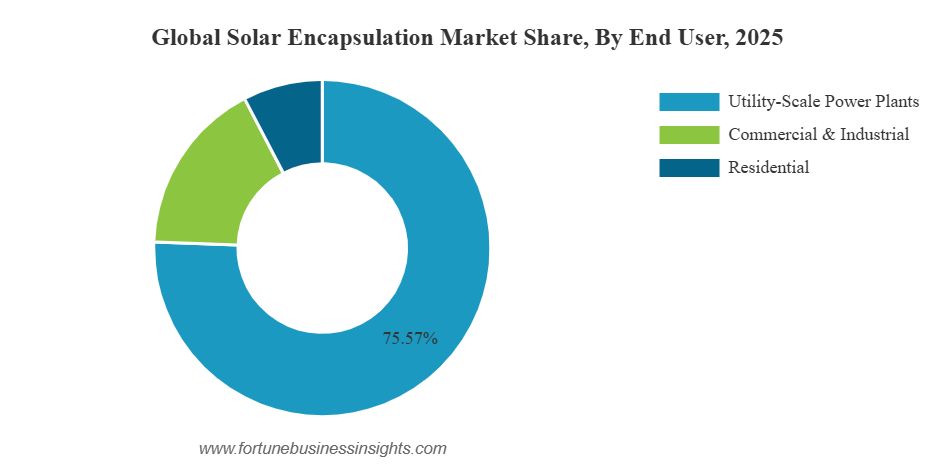
Solar Encapsulation Market Share
Global solar encapsulation market poised to grow from USD 9.98 billion in 2025 to USD 19.86 billion by 2034 at a CAGR of 7.79%
NEW YORK, NY, UNITED STATES, February 6, 2026 /EINPresswire.com/ -- The global solar encapsulation market size was valued at USD 9.98 billion in 2025. It is projected to grow from USD 10.90 billion in 2026 to USD 19.86 billion by 2034, exhibiting a CAGR of 7.79% during the forecast period. The solar encapsulation market plays a critical role in the photovoltaic (PV) value chain by protecting solar cells from environmental damage, moisture, and mechanical stress. Encapsulation materials enhance the durability, efficiency, and lifespan of solar modules, making them essential for long-term solar power generation. The market is growing steadily, driven by rising global solar installations, supportive government policies, and continuous advancements in encapsulation materials.Get a Free Sample of this Report: https://www.fortunebusinessinsights.com/enquiry/request-sample-pdf/solar-encapsulation-market-113040
Key Market Insights
Ethylene-vinyl acetate (EVA) continues to be the most widely used solar encapsulation material, owing to its proven performance, cost effectiveness, and compatibility with a wide range of photovoltaic module technologies. At the same time, adoption of polyolefin elastomer (POE) is increasing, particularly in high-efficiency and bifacial solar modules, due to its superior moisture resistance and long-term durability. Strong demand from both utility-scale solar installations and rooftop photovoltaic projects is further driving market growth. Additionally, the Asia Pacific region dominates the production and consumption of solar encapsulation materials, supported by large-scale solar manufacturing hubs, expanding renewable energy capacity, and supportive government policies promoting solar power deployment.
Market Trends
The solar encapsulation materials market is witnessing an increasing shift toward POE-based encapsulants, driven by their superior moisture resistance and enhanced long-term performance compared to traditional materials. Demand is also rising for advanced encapsulation solutions tailored for bifacial and high-performance solar panels, where durability and efficiency are critical. Continuous improvements in UV resistance and thermal stability are further strengthening the reliability of encapsulants, helping extend module lifespan under harsh environmental conditions. In parallel, the expansion of thin-film and next-generation solar technologies is creating new opportunities for specialized encapsulation materials. These developments are collectively supporting technological advancement and sustained growth in the solar encapsulation materials market.
Market Growth Factors
The solar encapsulation materials market is strongly supported by the rapid growth in global solar energy installations, as countries accelerate the deployment of renewable power capacity. Government incentives, ambitious renewable energy targets, and decarbonization policies are encouraging large-scale investment in solar projects across both developed and emerging economies. At the same time, declining costs of solar modules and balance-of-system components are improving project economics, making solar energy more accessible and commercially viable. Technological advancements that enhance solar module efficiency, durability, and operational lifespan are further driving demand for high-quality encapsulation materials. Together, these factors are reinforcing the long-term growth outlook for the solar encapsulation materials market.
Segmentation Analysis
By Material Type:
• Ethylene-Vinyl Acetate (EVA)
• Polyolefin Elastomer (POE)
• Thermoplastic Polyurethane (TPU)
• Others
By Application:
• Crystalline Silicon Solar Modules
• Thin-Film Solar Modules
By End Use:
• Residential
• Commercial
• Utility-Scale
Speak to Analyst: https://www.fortunebusinessinsights.com/enquiry/speak-to-analyst/solar-encapsulation-market-113040
Regional Analysis
Asia Pacific dominates the solar encapsulation materials market, supported by large-scale solar manufacturing capabilities, strong government support, and high levels of solar installations across China, India, and Southeast Asia. North America is experiencing significant growth, driven by the expansion of utility-scale solar projects and increasing adoption of rooftop solar systems in residential and commercial sectors. Europe continues to witness steady market growth, backed by strict renewable energy mandates, carbon reduction goals, and sustained investments in clean energy infrastructure. Meanwhile, Latin America and the Middle East & Africa are emerging as promising growth regions, supported by increasing solar capacity additions, improving policy frameworks, and favorable climatic conditions that support large-scale solar power generation.
Key Industry Players
• Hangzhou First PV Material Co., Ltd. (China)
• Sinopont (China)
• Hanwha Solutions / Hanwha Chemical (South Korea)
• 3M Company (United States)
• STR Holdings, Inc. (United States)
• HIUV New Materials (China)
• Betterial New Materials (China)
• Cybrid Technologies (China)
• Mitsui Chemicals, Inc. (Japan)
• Sveck (Changzhou Sveck Technology Co., Ltd.) (China)
• RenewSys India Pvt. Ltd. (India)
• DuPont (United States)
• Celanese (United States)
• Vishakha Renewables (India)
• Crown Advanced Material Co., Ltd. (China)
Key Industry Developments
• In December 2025, RenewSys entered into a supply agreement with ZNShine Solarworld, a wholly owned subsidiary of Solarworld Energy Solutions, to provide solar encapsulation materials. The contract covers 400 MW of encapsulants scheduled for delivery between November 2025 and February 2026. This agreement reflects the increasing demand for advanced, high-efficiency encapsulation solutions as solar module manufacturers continue to shift toward next-generation cell technologies.
Future Outlook
The solar encapsulation market is expected to experience sustained growth over the forecast period, supported by the rapid acceleration of solar energy deployment across utility-scale, commercial, and residential applications. Advancements in photovoltaic module technologies, including bifacial, high-efficiency, and next-generation solar panels, are increasing the need for durable and high-performance encapsulation materials. The industry is steadily transitioning toward advanced solutions that offer superior moisture resistance, UV stability, and long-term reliability to extend module lifespan and performance. Continued innovation in material science is enabling the development of encapsulants that meet evolving technical and environmental requirements. Additionally, supportive government policies, declining solar system costs, and rising investments in renewable energy infrastructure are further strengthening market opportunities and long-term growth prospects.
Read Related Insights:
Solar Carport Market
Solar Panel Recycling Market
Ashwin Arora
Fortune Business Insights™ Pvt. Ltd.
+1 833-909-2966
sales@fortunebusinessinsights.com
Legal Disclaimer:
EIN Presswire provides this news content "as is" without warranty of any kind. We do not accept any responsibility or liability for the accuracy, content, images, videos, licenses, completeness, legality, or reliability of the information contained in this article. If you have any complaints or copyright issues related to this article, kindly contact the author above.
