
2-Ethyl EDOT Market to Reach USD 33.16 Billion by 2036, Asia Pacific Leads with 3M, Merck & Sigma-Aldrich Driving Growth
2-ethyl-3,4-ethylenedioxythiophene market
Rising demand for conductive polymers in OLED displays, solar cells, and flexible electronics accelerates global 2-Ethyl EDOT market growth through 2036.
NEWARK, DE, UNITED STATES, March 31, 2026 /EINPresswire.com/ -- The global 2-Ethyl-3,4-ethylenedioxythiophene (EDOT) market is valued at USD 22.84 billion in 2026 and is projected to reach USD 33.16 billion by 2036, expanding at a CAGR of 3.80% during the forecast period. Growth is driven by rising demand for conductive polymers across OLED displays, perovskite solar cells, flexible electronics, and advanced energy storage systems.
As electronic device manufacturing shifts toward miniaturization, flexibility, and enhanced performance, 2-ethyl EDOT is emerging as a critical specialty monomer. Its ability to improve solubility and processing efficiency in PEDOT polymers positions it as a strategic material in modern electronics and optoelectronic applications.
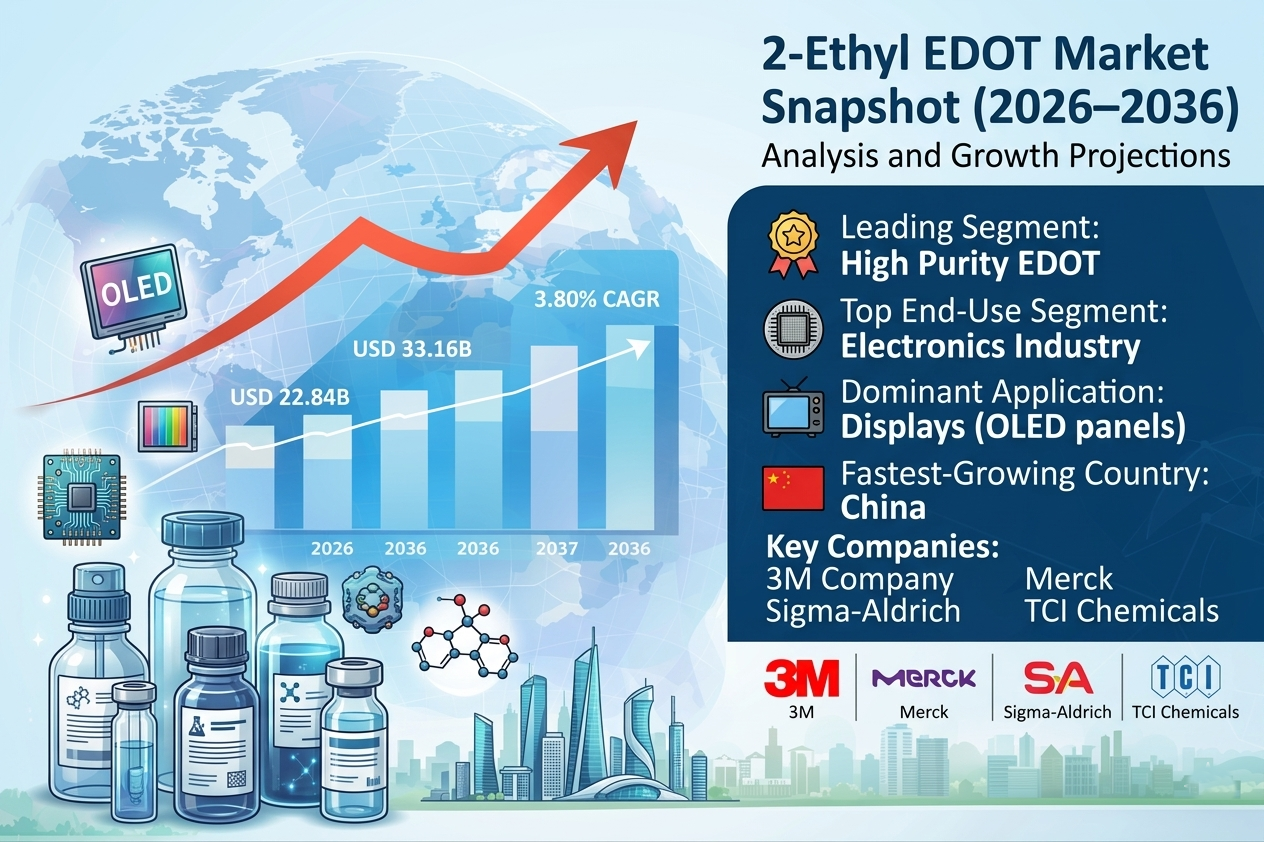
2-Ethyl EDOT Market Snapshot (2026–2036)
• Market size in 2026: USD 22.84 billion
• Market size in 2036: USD 33.16 billion
• CAGR (2026–2036): ~3.80%
• Leading segment: High purity EDOT
• Top end-use segment: Electronics industry
• Dominant application: Displays (OLED panels)
• Fastest-growing country: China
• Key companies: 3M Company, Merck, Sigma-Aldrich, TCI Chemicals
Market Momentum
The 2-ethyl EDOT market begins at USD 22.84 billion in 2026, supported by increasing OLED display production and conductive polymer demand. Between 2027 and 2030, rising investments in flexible electronics, wearable devices, and energy storage systems accelerate adoption across Asia Pacific and developed economies.
Entering 2032 and beyond, commercialization of perovskite solar cells, advancements in polymer coating technologies, and expansion of printed electronics manufacturing further strengthen demand. By 2036, the market reaches USD 33.16 billion, driven by widespread application in displays, sensors, capacitors, and emerging bioelectronic devices.
Request For Sample Report | Customize Report | Purchase Full Report
https://www.futuremarketinsights.com/reports/sample/rep-gb-25915
Why the Market is Growing
The 2-Ethyl-3,4-ethylenedioxythiophene market is expanding as industries increasingly adopt advanced conductive polymers for high-performance electronic applications. The material serves as a key precursor for PEDOT, which is widely used for its electrical conductivity, transparency, and stability.
One of the primary growth drivers is the expansion of OLED display manufacturing by leading companies, where PEDOT-based films replace traditional materials like ITO. Additionally, perovskite solar cell commercialization is creating strong demand for EDOT-based hole transport layers.
The compound’s enhanced solubility allows for efficient processing techniques such as inkjet printing, spin coating, and slot-die deposition, enabling large-scale production of flexible and lightweight electronic devices. Furthermore, the transition toward solid polymer capacitors in automotive and industrial applications is boosting consumption.
Sustainability and innovation trends are also shaping the market, with increasing investments in high-purity synthesis and environmentally efficient production methods.
Segment Spotlight
1. Purity: High Purity EDOT Leads Market Share
High purity EDOT accounts for approximately 63.2% of the market, driven by its essential role in ensuring consistent electrical performance in thin-film electronics and optoelectronic applications.
2. Application: Displays Segment Dominates
Displays hold around 27.9% market share, supported by the rapid growth of OLED panels, flexible displays, and touchscreen technologies requiring transparent conductive films.
3. End Use: Electronics Industry Leads
The electronics sector commands nearly 38.7% share, reflecting extensive use in sensors, printed electronics, capacitors, and wearable devices.
Drivers, Opportunities, Trends, Challenges
• Drivers: Rising demand for conductive polymers, OLED expansion, flexible electronics adoption
• Opportunities: Growth in perovskite solar cells, energy storage systems, wearable technology
• Trends: Advanced polymerization techniques, printed electronics, miniaturization of devices
• Challenges: High production costs, purity requirements, complex synthesis processes
Country Growth Outlook (2026–2036)
China leads the market with a CAGR of 5.1%, driven by strong electronics manufacturing and renewable energy expansion. India follows at 4.8%, supported by growth in flexible electronics and polymer industries. Germany (4.4%) and France (4.0%) show steady adoption due to advanced material innovation, while the UK (3.6%) and USA (3.2%) maintain consistent growth. Brazil records a CAGR of 2.9%, reflecting gradual adoption in emerging applications.
Competitive Landscape
The market is highly competitive, with key players focusing on high-purity monomer production, advanced synthesis technologies, and global distribution expansion. Companies such as 3M Company, Sigma-Aldrich, Merck, and TCI Chemicals are investing in product innovation, ensuring consistency and scalability for industrial and research applications.
Competition is increasingly centered on purity standards, polymer performance, and application-specific customization. Strategic initiatives include strengthening supply chains, expanding production capabilities, and developing specialized solutions for next-generation electronics and energy devices.
Frequently Asked Questions (FAQ)
What is the global 2-Ethyl EDOT market size?
The market is valued at USD 22.84 billion in 2026 and is projected to reach USD 33.16 billion by 2036.
At what rate is the market expected to grow?
The market is forecast to expand at a CAGR of approximately 3.80% from 2026 to 2036.
What is 2-Ethyl-3,4-ethylenedioxythiophene?
It is a conductive monomer used in the production of PEDOT polymers for applications in electronics, solar cells, and sensors.
Why is EDOT gaining importance?
Its ability to enhance conductivity, flexibility, and processability makes it essential for advanced electronic and optoelectronic applications.
Explore More Related Studies Published by FMI Research
Bulk Molding Compounds Market
https://www.futuremarketinsights.com/reports/bulk-molding-compounds-market
High Temperature Grease Market
https://www.futuremarketinsights.com/reports/high-temperature-grease-market
Emulsion Polymers Market
https://www.futuremarketinsights.com/reports/emulsion-polymers-market
About Future Market Insights (FMI)
Future Market Insights, Inc. (FMI) is an ESOMAR-certified, ISO 9001:2015 market research and consulting organization, trusted by Fortune 500 companies and global enterprises. With a global presence across the U.S., UK, India, and the Middle East, FMI delivers data-driven insights across 30+ industries and over 1200 markets.
Why Choose FMI:
https://www.futuremarketinsights.com/why-fmi
Sudip Saha
Future Market Insights Inc.
+ +1 347-918-3531
rahul.singh@futuremarketinsights.com
Legal Disclaimer:
EIN Presswire provides this news content "as is" without warranty of any kind. We do not accept any responsibility or liability for the accuracy, content, images, videos, licenses, completeness, legality, or reliability of the information contained in this article. If you have any complaints or copyright issues related to this article, kindly contact the author above.
