

Enerdatics Releases M&A Signals from the Queue, Mapping 780 GW in US Interconnection Queues
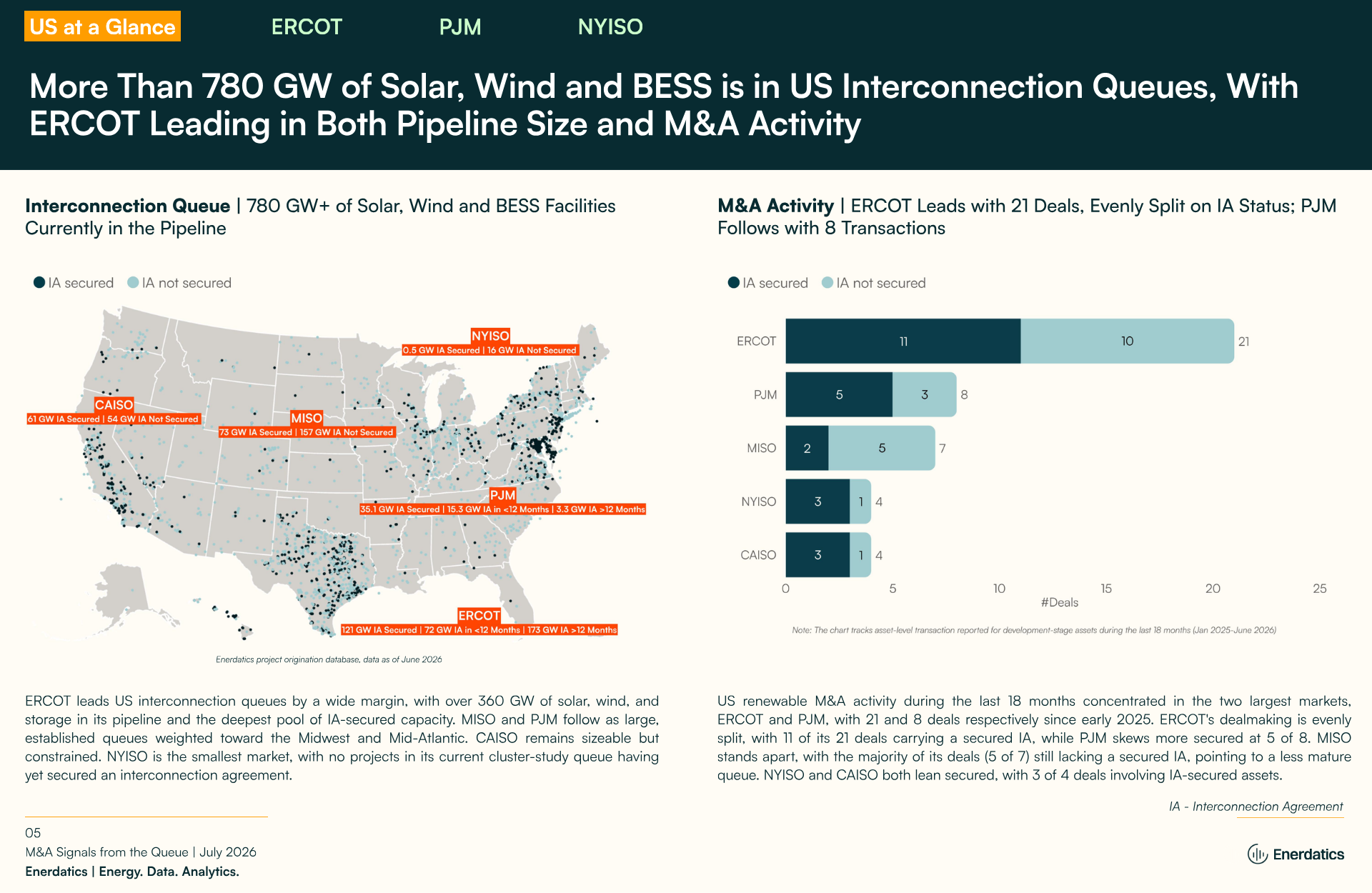
M&A Signals from the Queue maps development pipelines across ERCOT, PJM and NYISO, separating IA-secured capacity from projects still in study.
Only a fraction of the 780 GW in US interconnection queues holds a signed agreement. The report shows where that capacity sits and who is holding it.
More than 780 GW of solar, wind and battery storage capacity is currently progressing through US interconnection queues. The report examines ERCOT, PJM and NYISO, the three markets that matter most to acquirers, which together hold more than 425 GW. It separates capacity that already holds an executed interconnection agreement (IA) from capacity still moving through study.
That distinction now drives deal activity more than pipeline size does. Across the five largest ISOs, 44 development-stage assets have traded since January 2025, and buyers have consistently favored projects where interconnection risk is either resolved or clearly visible.
Deal Activity Is Concentrated in Two Markets
ERCOT and PJM account for the majority of recent transactions, with 21 and 8 development-stage deals respectively since early 2025. ERCOT's dealmaking is evenly split on interconnection status, with 11 of its 21 deals carrying a secured IA. PJM skews more de-risked, at 5 of 8.
MISO stands apart. The majority of its deals, 5 of 7, still lacked a secured IA at the time of transaction, pointing to a less mature queue. NYISO and CAISO both lean secured, with 3 of 4 deals in each market involving IA-secured assets.
ERCOT Holds the Deepest Pool of Secured Capacity
More than 360 GW is progressing through ERCOT's queue, including over 120 GW with secured IAs, split across 65 GW of solar, 19 GW of wind and 37 GW of BESS. Most secured projects sit around the Panhandle and Dallas, but recent acquisitions show buyer interest moving into the South and Houston regions.
Battery storage dominates the near term. Around 43 GW of BESS is expected to secure an IA within the next 12 months, accounting for nearly 60 percent of that cohort. A large share of it remains untapped, making it the deepest near-IA storage pool available before competition tightens.
Beyond that sits more than 173 GW of early-stage pipeline across 820 projects, expected to reach IA over 12 to 36 months. Appetite at this stage is real, with firms including Sabanci Holdings, Cox Energy and Gridstor all having acquired early-stage ERCOT assets since the start of 2025.
Wind is the exception. Despite a sizeable IA-secured wind pipeline in the Panhandle, no development-stage wind asset in ERCOT has traded in the last two to three years.
Among developers with a track record of divestitures actively advancing assets through ERCOT's queue, the report profiles OCI Energy, Belltown Power, Savion, Enfinity, Advanced Power and Balanced Rock Power, with pipeline size, technology mix, zone and interconnection status set out for each.
PJM's Advanced Pipeline Is Solar-Led, While Its Reformed Queue Is Dominated by Gas
PJM's advanced-stage pipeline includes more than 50 GW, with solar accounting for the largest share at approximately 27 GW of IA-secured capacity, against 4.5 GW of wind and 4 GW of BESS. Illinois leads the secured cohort with 7.8 GW, followed by Ohio at 6.9 GW.
Virginia presents a different picture. Despite holding 6.6 GW of IA-secured capacity, M&A activity there remains limited, reflecting a develop-and-hold strategy as owners retain projects to serve rising in-state load.
Behind the advanced pipeline sits a much larger and much younger queue. PJM has moved from its legacy serial process to a cycle-based framework, and Cycle 1 received 811 applications totaling 220 GW. Natural gas accounts for the single largest share of that capacity at 105.8 GW, or 48 percent. Renewables and storage make up 44 percent of capacity but 76 percent of projects, at 612 filings.
The reform is designed to cut time to an IA from four or five years to one or two, using 100 percent site control requirements, study deposits and readiness deposits to screen out speculative filings. Clearing the queue is not the same as steel in the ground. Around 53 GW already holds signed agreements yet remains slowed by permitting, siting and supply-chain constraints outside PJM's control.
In PJM, the report profiles Invenergy, RWE, EDF and Deriva Energy as developers advancing sizeable pipelines through the queue, alongside recent pre-IA transactions involving Exus Renewables and TerraForm Power.
NYISO's Secured Market Is Thin, But Its Downstate Storage Pool Is Not
NYISO's queue stands at approximately 16 GW. Only around 550 MW across ten projects has secured an IA, and that pool is highly fragmented, with assets averaging about 50 MW across nine upstate counties. Solar leads at 327 MW, while a single 205 MW battery project in Dutchess County is the only storage asset in the group.
The remaining 15.8 GW is pre-IA and spread across 110 projects, led by 11.4 GW of battery storage. Nearly half the battery pipeline sits downstate across New York City and Long Island, and that downstate pipeline is entirely storage, reflecting high load density and grid constraints.
A clear gap has opened. Every utility-scale transaction in NYISO since early 2025 has been upstate solar, while no downstate battery asset has traded. For buyers willing to underwrite projects ahead of interconnection, downstate storage is the largest and most strategically located pool still open.
The seller pool in NYISO remains thin. The report identifies RWE, Solv Energy and EDF as the developers most worth tracking, each with a demonstrated pattern of monetizing development-stage assets.
Where Buyers Should Focus
The report closes with a market-specific playbook rather than a capacity-led one. Move early on near-IA storage in ERCOT, track readiness before paying up in PJM, and engage downstate BESS ahead of IA in NYISO.
Now Available Through Leap
The report's underlying dataset is also live inside Enerdatics Leap, the company's AI native deal intelligence platform. Users can query the findings directly in natural language and run the same screen against markets beyond the three covered here.
Availability
M&A Signals from the Queue is available at no cost. Readers can register at https://www.enerdatics.com/enerdatics-queue-report-registration-page for immediate access.
M S Pradeep
Enerdatics Services Private Limited
+1 832-699-9293
email us here
Legal Disclaimer:
EIN Presswire provides this news content "as is" without warranty of any kind. We do not accept any responsibility or liability for the accuracy, content, images, videos, licenses, completeness, legality, or reliability of the information contained in this article. If you have any complaints or copyright issues related to this article, kindly contact the author above.
